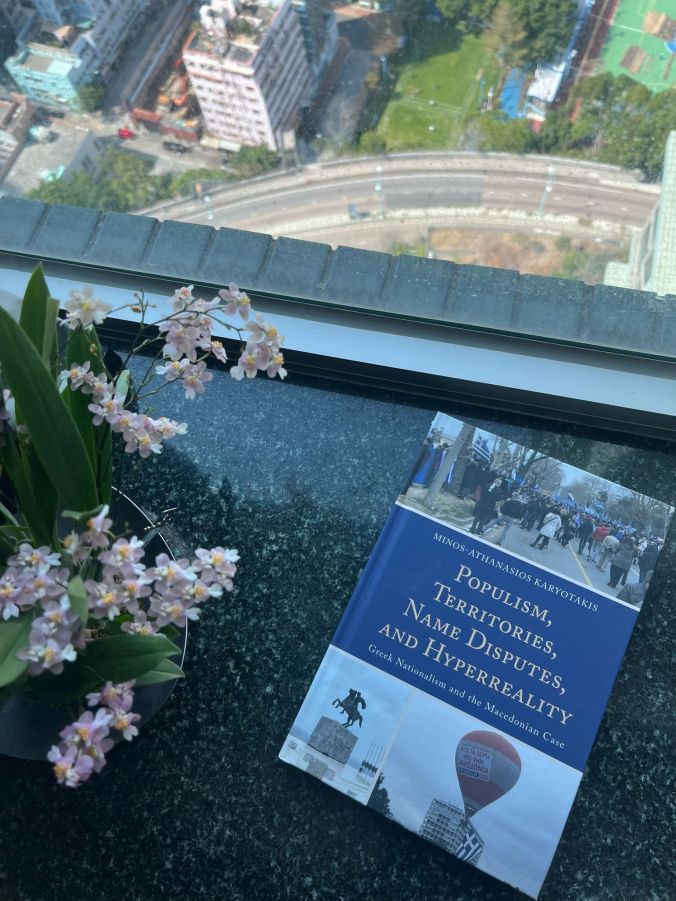
In February 2025, my book in English entitled “Populism, Territories, Name Disputes, and Hyperreality: Greek Nationalism and the Macedonian Case” was released by the well-known publishing house Rowman & Littlefield, which was recently purchased by the renowned publishing giant Bloomsbury. This book results from about 5+ years of work dealing with Macedonia and its recent events, namely the Prespa Agreement. It is the first book that creates a niche categorization of territorial disputes based on Macedonia, showing that similar tactics are being applied in other places worldwide, such as with the American President and the Gulf of Mexico.
The first chapter is called “The Influence of Territorial Names and the Symbolic Name Disputes (SNDs),” where I highlight the new categorization and explain the significance of these disputes with examples and a thorough analysis of the relevant scientific bibliography. Essentially, I explain that thanks to the Macedonian Name Dispute, a supposedly improved version of reality has been created for Greeks (Hyperreality), which is not in line with the truth.
The second chapter is called “The Macedonian Name Dispute (MND): Electoral Power, Populism, and the Prespes Agreement”, where through a historical analysis I explain how the Macedonian name has been used throughout time as a tool by the elites for electoral benefits, for personal pursuits and to create societal divisions. As it was written recently, an attempt was made to include the positions of all the new parties, including Zoe Konstantopoulou. Unfortunately, there is no detailed reference to Afrodite Latinopoulou, although there is a reference in an interview to her being an influential figure in the New Democracy (ND) political party and a personal choice of the Prime Minister, Kyriakos Mitsotakis.
The third chapter is called “Greece’s Political Actors and the Perceived Power of the MND”, including the most important research of the book. Through 42 interviews with influential political figures (e.g. Ministers) of the Prespa Agreement period from many political spheres, mainly of the then government and the current one, a vivid depiction of the power of the Macedonian issue in Greece is given. This study is one of most extensive in the field of Gewwk studies until today, as it involves face-to-face interviews with many influential political actors. Among other things, (1) a systematic effort to instrumentalize the Macedonian issue and present it as an existential threat to the country is highlighted. (2) The media and journalists are manipulated (?) to support this existential threat. (3) The interviewees present the media as the most powerful institution in the country and accuse them of being able to overthrow governments whenever they want. (4) These actors call for significant changes in the media and show appreciation for investigative journalism, without, however, seriously criticizing themselves for being or having been in positions of power.
The fourth chapter is called “The Use of the MND on Facebook in the Mayoral Elections of 2019 in Thessaloniki”, where it deals with the importance of Thessaloniki for the MND and how the mayoral candidates in 2019 used the Agreement during their election campaign on Facebook. The posts of the most important candidates are analyzed: Zervas, Tachiaos, Orfanos, Notopoulou, Vougias, and Psomiadis. The results show that the right-wing candidates used the Macedonian and the upcoming Agreement significantly to gain greater electoral power. Often, the posts were dramatized and maintained this idea of a threat to the country. The “progressive bloc,” on the other hand, made an effort only through Notopoulou to support the Agreement, which campaign was not as targeted and continuous as that of her right-wing colleagues.
The last chapter, “Toward Despotisms or Time for Brave Changes?”, highlights that the Macedonian is not a unique case as the Greeks believe, but a general phenomenon throughout the world, which is used, among other things, in the social and political arena to violate freedoms, promote hatred and as a useful tool in the hands of those who want to create new despotic regimes and injure democracy. The period 2018-2019 highlights significant problems in the democratic functioning of the country and sounds the alarm. This chapter also proposes solutions to address the relevant phenomenon and predicts that it will intensify in the coming years if institutions do not try to tackle the phenomenon. Reality confirmed me since Trump recently followed this path with the Gulf of Mexico.
So far, the book is participating in an international competition for an award/distinction from a major academic organization, has gained the interest of important scientists and organizations worldwide, and is considered to have a significant impact in various fields such as geography, linguistics, communication, politics, journalism, etc.
You can see the book details on the following link: https://rowman.com/ISBN/9781666950069/Populism-Territories-Name-Disputes-and-Hyperreality-Greek-Nationalism-and-the-Macedonian-Case
 Website