Are We Creators of Our Own Demise? Why You Should Not Ignore the Devastating Wildfires in Los Angeles and Greece

Published by Australian Institute of International Affairs (24 Feb 2025): https://www.internationalaffairs.org.au/australianoutlook/are-we-creators-of-our-own-demise-why-you-should-not-ignore-the-devastating-wildfires-in-los-angeles-and-greece/

The Los Angeles Wildfires, like similar events in other countries, including Greece, reveal the urgency of immediate action to reduce environmental damage and stop political games for electoral purposes.

On Sunday, 26 January 2025, the new president of the United States of America, Donald Trump, issued an executive order permitting the federal government to override California’s water management practices if found inadequate. Trump said in a post on Truth Social (a social media platform owned by Trump himself, created after he was banned from Twitter and Facebook in 2021): “Governor Gavin Newscum [sic.] refused to sign the water restoration declaration put before him that would have allowed millions of gallons of water, from excess rain and snow, melt from the North, to flow daily into many parts of California, including the areas that are currently burning in a virtually apocalyptic way. He wanted to protect an essentially worthless fish called a smelt, by giving it less water (it didn’t work!), but didn’t care about the people of California. Now the ultimate price is being paid. I will demand that this incompetent governor allow beautiful, clean, fresh water to FLOW INTO CALIFORNIA! He is the blame for this. On top of it all, no water for fire hydrants, and no firefighting planes. A true disaster!”—a misleading statement presenting the disaster as a problem of mismanagement. 

Continue reading →
From “Gulf of Mexico” to “Gulf of America”: More Division for the United States?

Published by Australian Institute of International Affairs (07 Feb 2025): From “Gulf of Mexico” to “Gulf of America”: More Division for the United States? – Australian Institute of International Affairs

By examining other territorial name disputes worldwide, we know that renaming the Gulf of Mexico could potentially promote division, identity politics, and undemocratic practices. These changes could develop into a new and existential threat for the US.

On Monday, 20 January 2025, it was announced that the new president of the United States of America, Donald Trump, issued an executive order to rename the Gulf of Mexico to the Gulf of America, aiming to promote American greatness.

As such, within 30 days of the date of this order, the Secretary of the Interior shall, consistent with 43 U.S.C. 364 through 364f, take all appropriate actions to rename as the “Gulf of America” the U.S. Continental Shelf area bounded on the northeast, north, and northwest by the States of Texas, Louisiana, Mississippi, Alabama and Florida and extending to the seaward boundary with Mexico and Cuba in the area formerly named as the Gulf of Mexico. The Secretary shall subsequently update the GNIS to reflect the renaming of the Gulf and remove all references to the Gulf of Mexico from the GNIS, consistent with applicable law. The Board shall provide guidance to ensure all federal references to the Gulf of America, including on agency maps, contracts, and other documents and communications shall reflect its renaming, says part of the executive order uploaded online at the official website of the White House.

Continue reading →

The only Hong Kong-Based AXA post-doctoral fellowship awardee tackles environmental misinformation and democracy in the AI Era

When floods, smog or wildfires make headlines, facts are not always the only thing that shapes public response. In an age of AI-generated images, conspiracy-filled feeds and polarised debate, what people believe about an environmental crisis can be as consequential as the crisis itself.

For Dr Minos Athanasios Karyotakis, a postdoctoral researcher at David C. Lam Institute for East-West Studies under the Faculty of Arts and Social Sciences at Hong Kong Baptist University (HKBU), that tension sits at the heart of his work. He became the only Hong Kong-based scholar to receive the prestigious AXA Post-Doctoral Fellowship under the AXA Research Fund in 2024.

Continue reading →

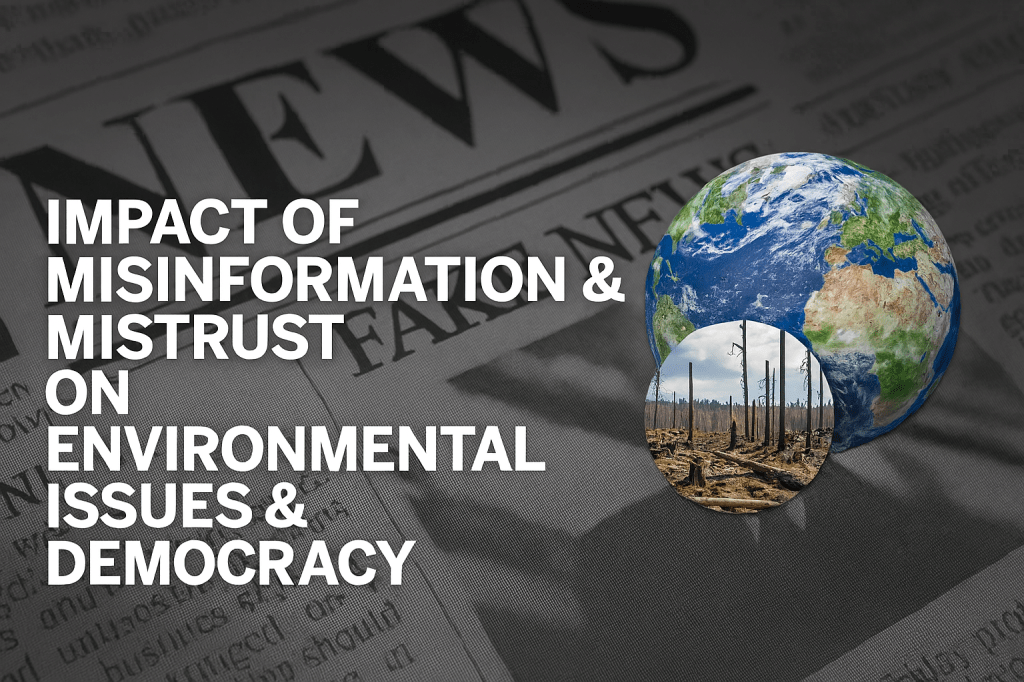
AXA Research Grant: Impact of Misinformation & Mistrust on Environmental Issues & Democracy: A Comparative Study

Source: Created with Microsoft Copilot

In an era where wildfires rage across Europe, water crises grip the US, and massive infrastructure projects like China’s Belt and Road Initiative (BRI) reshape global landscapes, two invisible forces are amplifying the chaos: misinformation and environmental decline. Fueled by AI’s rapid evolution, false narratives spread rapidly online, eroding public trust, polarizing societies, and even weakening democratic processes. As a result, this two-year project with the shortened title “Impact of Misinformation & Mistrust on Environmental Issues & Democracy: A Comparative Study” aims to offer real solutions to fight back, as well as reveal ideological patterns of online news discourse that have not been studied before to such an extent. The project, funded by the AXA Research Fund and hosted at Hong Kong Baptist University, dives deep into how digital falsehoods distort our understanding of environmental disasters, turning urgent global challenges into battlegrounds for division and manipulation.

Continue reading →

The Belt and Road Initiative and the 21st-century Maritime Silk Road: A Global Study From Europe to the Asia-Pacific (Monograph in Progress, Springer)

Photo Source: https://www.marineinsight.com/maritime-history/maritime-silk-routes-the-story-of-the-oldest-trade-routes/

I am delighted to announce that, over the next 2 years, a book on the maritime aspect of the Belt and Road Initiative (BRI) will be co-authored with Associate Professor Kevin LO, an authority on Global China and the BRI.

Continue reading →

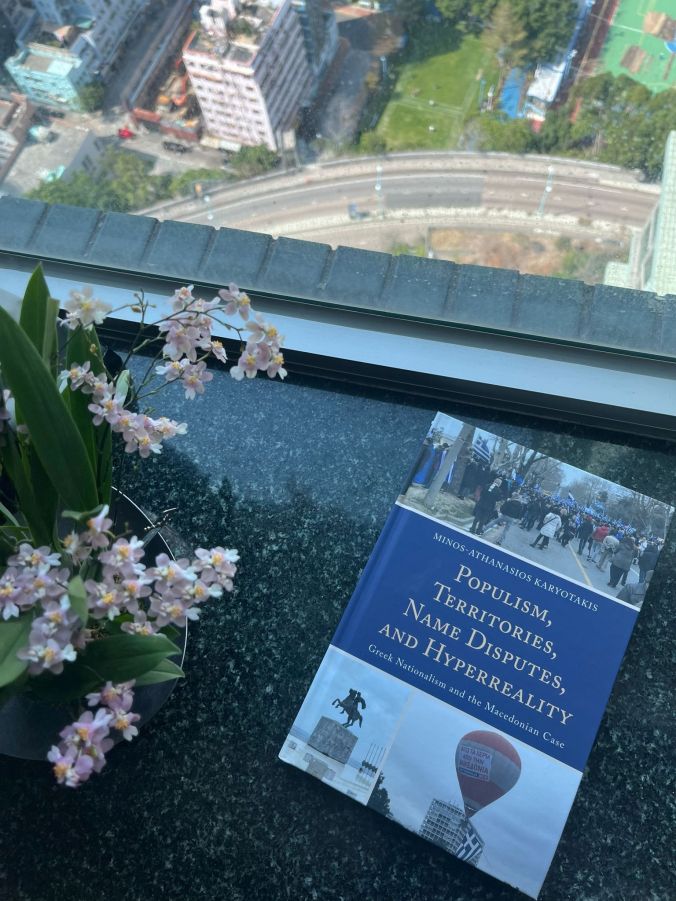
Populism, Territories, Name Disputes, and Hyperreality: Greek Nationalism and the Macedonian Case

In February 2025, my book in English entitled “Populism, Territories, Name Disputes, and Hyperreality: Greek Nationalism and the Macedonian Case” was released by the well-known publishing house Rowman & Littlefield, which was recently purchased by the renowned publishing giant Bloomsbury. This book results from about 5+ years of work dealing with Macedonia and its recent events, namely the Prespa Agreement. It is the first book that creates a niche categorization of territorial disputes based on Macedonia, showing that similar tactics are being applied in other places worldwide, such as with the American President and the Gulf of Mexico.

Continue reading →

Λαϊκισμός, Εδάφη, Διαφωνίες ονομάτων και Υπερπραγματικότητα: Ελληνικός Εθνικισμός και η Μακεδονική Υπόθεση (Post in Greek)

Πριν από τρεις μέρες κυκλοφόρησε το βιβλίο μου στα Αγγλικά με τίτλο «Λαϊκισμός, Εδάφη, Διαφωνίες ονομάτων και Υπερπραγματικότητα: Ελληνικός Εθνικισμός και η Μακεδονική Υπόθεση» (“Populism, Territories, Name Disputes, and Hyperreality: Greek Nationalism and the Macedonian Case”) από τον γνωστό εκδοτικό οίκο Rowman & Littlefield, οποίος αγοράστηκε πρόσφατα από τον πασίγνωστο εκδοτικό κολοσσό “Bloomsbury.” Το βιβλίο αυτό είναι απότοκο μιας δουλειάς περίπου 5+ χρόνων ασχολούμενος με το Μακεδονικό και τα πρόσφατα γεγονότα, δηλαδή την Συμφωνία των Πρεσπών. Είναι το πρώτο βιβλίο που δημιουργεί μια καινούργια κατηγοριοποίηση για τις εδαφικές διαμάχες με βάση το Μακεδονικό, δείχνοντας ότι αντίστοιχες τακτικές εφαρμόζονται και σε άλλα μέρη ανά τον κόσμο, όπως πρόσφατα με τον Αμερικάνο Πρόεδρο και τον Κόλπο του Μεξικού.

Continue reading →

Is Sage Open an Actual Academic Journal?

On Saturday, 9 March 2024, I received a rejection decision from a non-academic individual from the journal Sage Open for a paper (SO-20-3070) that I had submitted on 29 August 2020 and that had received three positive peer reviews suggesting acceptance on 7 September 2021, raising questions about the journal’s academic merits.

The story of that weird academic experience started at the end of August 2020 when I submitted a paper of mine (SO-20-3070) at Sage Open because it dealt with general social sciences as a thematic focus, and it was open access with a fee of 800USD. I got a fast decision (Major Revision) on the 1st of December 2020, and reviews that were quite beneficial pointed out flaws in the paper and suggested how to correct them and strengthen the manuscript.

Continue reading →

Community views: obstacles to globalising media research

First Published on the website of the Global Media Studies Network (https://globalmediastudies.network/blog/obstacles-to-global-diversity/), MARCH 15, 2023

By Cherian George and Minos-Athanasios Karyotakis

When we asked our network how to make media studies research more globally diverse and inclusive, thoughtful responses arrived from every continent, from senior academics, early-career scholars, and PhD students. They talked about linguistic barriers; the lack of interest in the non-west among the field’s tastemakers; how a narrow understanding of theoretical rigour marginalises work on the Global South; and how performance metrics adopted by non-western universities undermines their own ability to serve their communities’ needs.

Continue reading →

‘Top-tier’ journals: Does a global reputation mean a global orientation?

By Cherian George and Minos-Athanasios Karyotakis

Academia as an industry has come to rely on journal impact factors as convenient proxy measures of faculty members’ research quality. As competition intensifies — among individuals, departments, and universities —  such bibliometrics have grown in importance. At many institutions, researchers are pushed to publish in journals that are highly ranked.

Many scholars of non-western societies have long noted, though, that “top-tier” journals, while international in reputation, are far from global in orientation. This is an issue that we and our colleagues in the Global Media Studies Network are keen to discuss.

Continue reading →