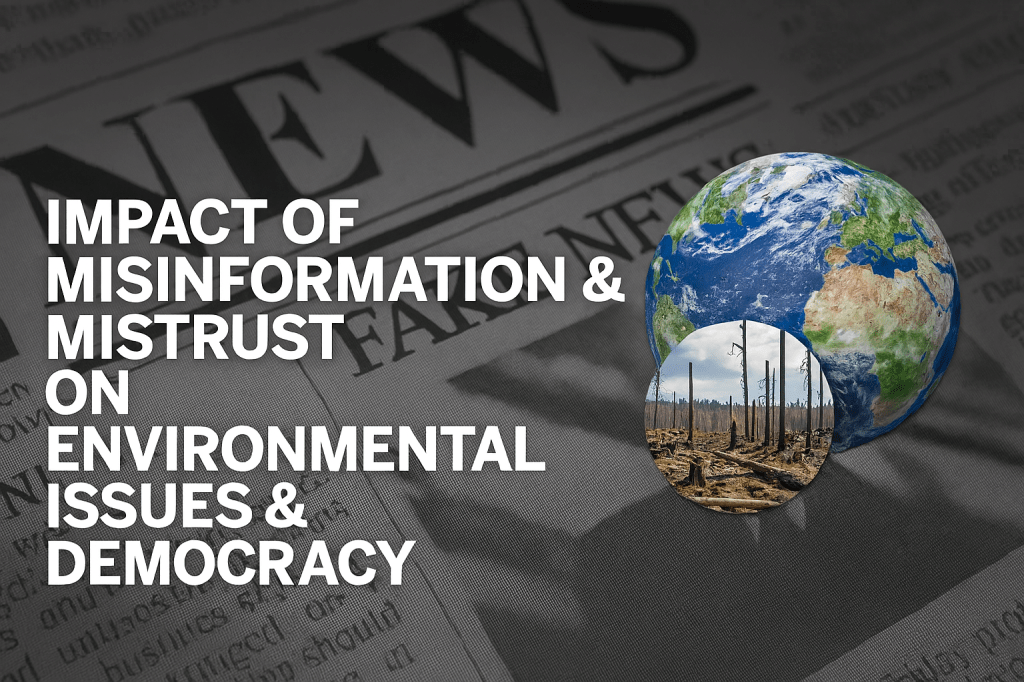
AXA Research Grant: Impact of Misinformation & Mistrust on Environmental Issues & Democracy: A Comparative Study

Source: Created with Microsoft Copilot

In an era where wildfires rage across Europe, water crises grip the US, and massive infrastructure projects like China’s Belt and Road Initiative (BRI) reshape global landscapes, two invisible forces are amplifying the chaos: misinformation and environmental decline. Fueled by AI’s rapid evolution, false narratives spread rapidly online, eroding public trust, polarizing societies, and even weakening democratic processes. As a result, this two-year project with the shortened title “Impact of Misinformation & Mistrust on Environmental Issues & Democracy: A Comparative Study” aims to offer real solutions to fight back, as well as reveal ideological patterns of online news discourse that have not been studied before to such an extent. The project, funded by the AXA Research Fund and hosted at Hong Kong Baptist University, dives deep into how digital falsehoods distort our understanding of environmental disasters, turning urgent global challenges into battlegrounds for division and manipulation.

Continue reading
The Belt and Road Initiative and the 21st-century Maritime Silk Road: A Global Study From Europe to the Asia-Pacific (Monograph in Progress, Springer)

Photo Source: https://www.marineinsight.com/maritime-history/maritime-silk-routes-the-story-of-the-oldest-trade-routes/

I am delighted to announce that, over the next 2 years, a book on the maritime aspect of the Belt and Road Initiative (BRI) will be co-authored with Associate Professor Kevin LO, an authority on Global China and the BRI.

Continue reading

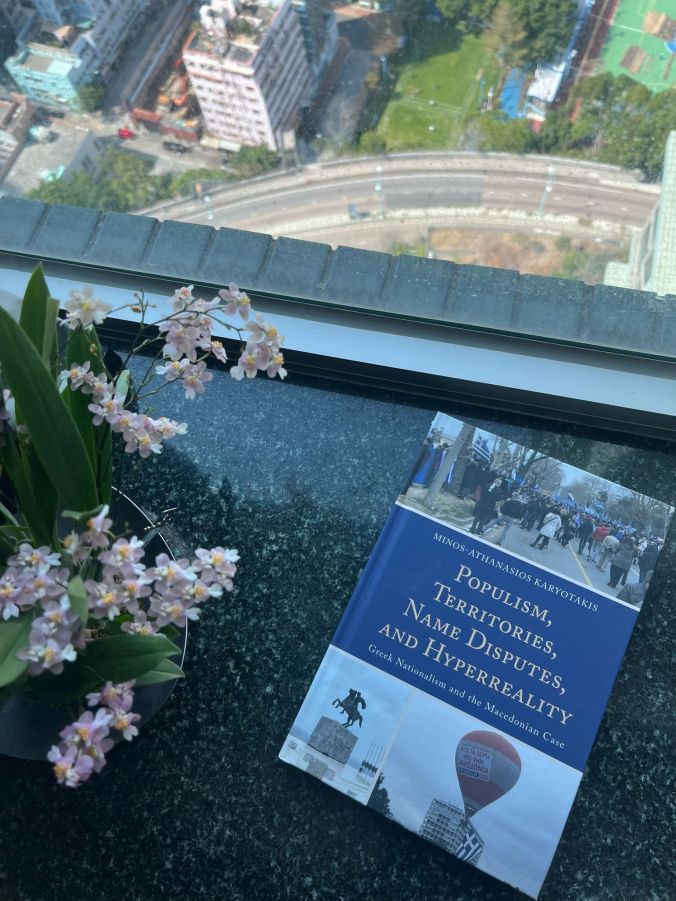
Populism, Territories, Name Disputes, and Hyperreality: Greek Nationalism and the Macedonian Case

In February 2025, my book in English entitled “Populism, Territories, Name Disputes, and Hyperreality: Greek Nationalism and the Macedonian Case” was released by the well-known publishing house Rowman & Littlefield, which was recently purchased by the renowned publishing giant Bloomsbury. This book results from about 5+ years of work dealing with Macedonia and its recent events, namely the Prespa Agreement. It is the first book that creates a niche categorization of territorial disputes based on Macedonia, showing that similar tactics are being applied in other places worldwide, such as with the American President and the Gulf of Mexico.

Continue reading

Λαϊκισμός, Εδάφη, Διαφωνίες ονομάτων και Υπερπραγματικότητα: Ελληνικός Εθνικισμός και η Μακεδονική Υπόθεση (Post in Greek)

Πριν από τρεις μέρες κυκλοφόρησε το βιβλίο μου στα Αγγλικά με τίτλο «Λαϊκισμός, Εδάφη, Διαφωνίες ονομάτων και Υπερπραγματικότητα: Ελληνικός Εθνικισμός και η Μακεδονική Υπόθεση» (“Populism, Territories, Name Disputes, and Hyperreality: Greek Nationalism and the Macedonian Case”) από τον γνωστό εκδοτικό οίκο Rowman & Littlefield, οποίος αγοράστηκε πρόσφατα από τον πασίγνωστο εκδοτικό κολοσσό “Bloomsbury.” Το βιβλίο αυτό είναι απότοκο μιας δουλειάς περίπου 5+ χρόνων ασχολούμενος με το Μακεδονικό και τα πρόσφατα γεγονότα, δηλαδή την Συμφωνία των Πρεσπών. Είναι το πρώτο βιβλίο που δημιουργεί μια καινούργια κατηγοριοποίηση για τις εδαφικές διαμάχες με βάση το Μακεδονικό, δείχνοντας ότι αντίστοιχες τακτικές εφαρμόζονται και σε άλλα μέρη ανά τον κόσμο, όπως πρόσφατα με τον Αμερικάνο Πρόεδρο και τον Κόλπο του Μεξικού.

Continue reading

Is Sage Open an Actual Academic Journal?

On Saturday, 9 March 2024, I received a rejection decision from a non-academic individual from the journal Sage Open for a paper (SO-20-3070) that I had submitted on 29 August 2020 and that had received three positive peer reviews suggesting acceptance on 7 September 2021, raising questions about the journal’s academic merits.

The story of that weird academic experience started at the end of August 2020 when I submitted a paper of mine (SO-20-3070) at Sage Open because it dealt with general social sciences as a thematic focus, and it was open access with a fee of 800USD. I got a fast decision (Major Revision) on the 1st of December 2020, and reviews that were quite beneficial pointed out flaws in the paper and suggested how to correct them and strengthen the manuscript.

Continue reading

Community views: obstacles to globalising media research

First Published on the website of the Global Media Studies Network (https://globalmediastudies.network/blog/obstacles-to-global-diversity/), MARCH 15, 2023

By Cherian George and Minos-Athanasios Karyotakis

When we asked our network how to make media studies research more globally diverse and inclusive, thoughtful responses arrived from every continent, from senior academics, early-career scholars, and PhD students. They talked about linguistic barriers; the lack of interest in the non-west among the field’s tastemakers; how a narrow understanding of theoretical rigour marginalises work on the Global South; and how performance metrics adopted by non-western universities undermines their own ability to serve their communities’ needs.

Continue reading

‘Top-tier’ journals: Does a global reputation mean a global orientation?

By Cherian George and Minos-Athanasios Karyotakis

Academia as an industry has come to rely on journal impact factors as convenient proxy measures of faculty members’ research quality. As competition intensifies — among individuals, departments, and universities —  such bibliometrics have grown in importance. At many institutions, researchers are pushed to publish in journals that are highly ranked.

Many scholars of non-western societies have long noted, though, that “top-tier” journals, while international in reputation, are far from global in orientation. This is an issue that we and our colleagues in the Global Media Studies Network are keen to discuss.

Continue reading